
llll light sculptural LED lighting


llll.01 — a minimal‑surface pendant with a  sculptural presence

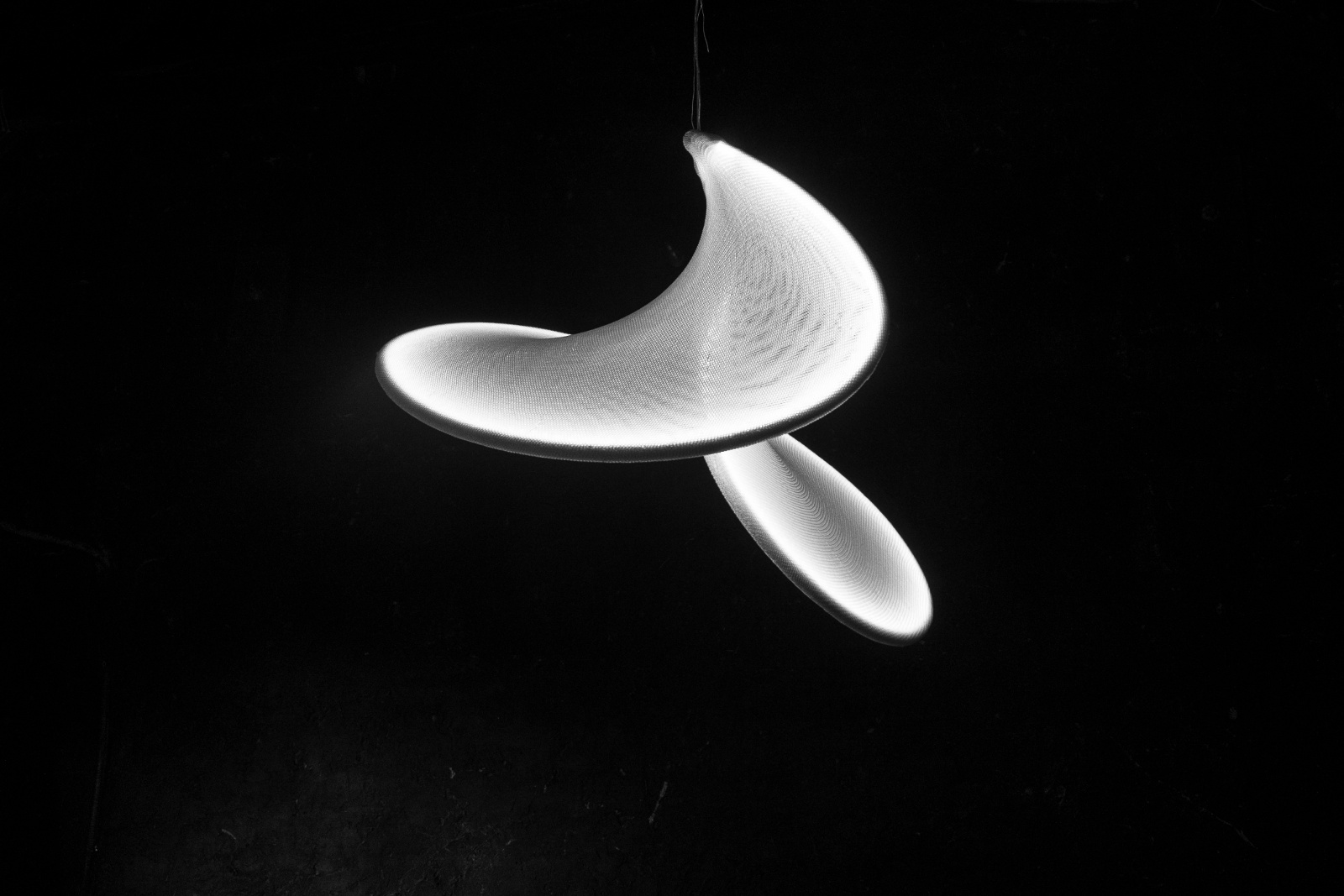
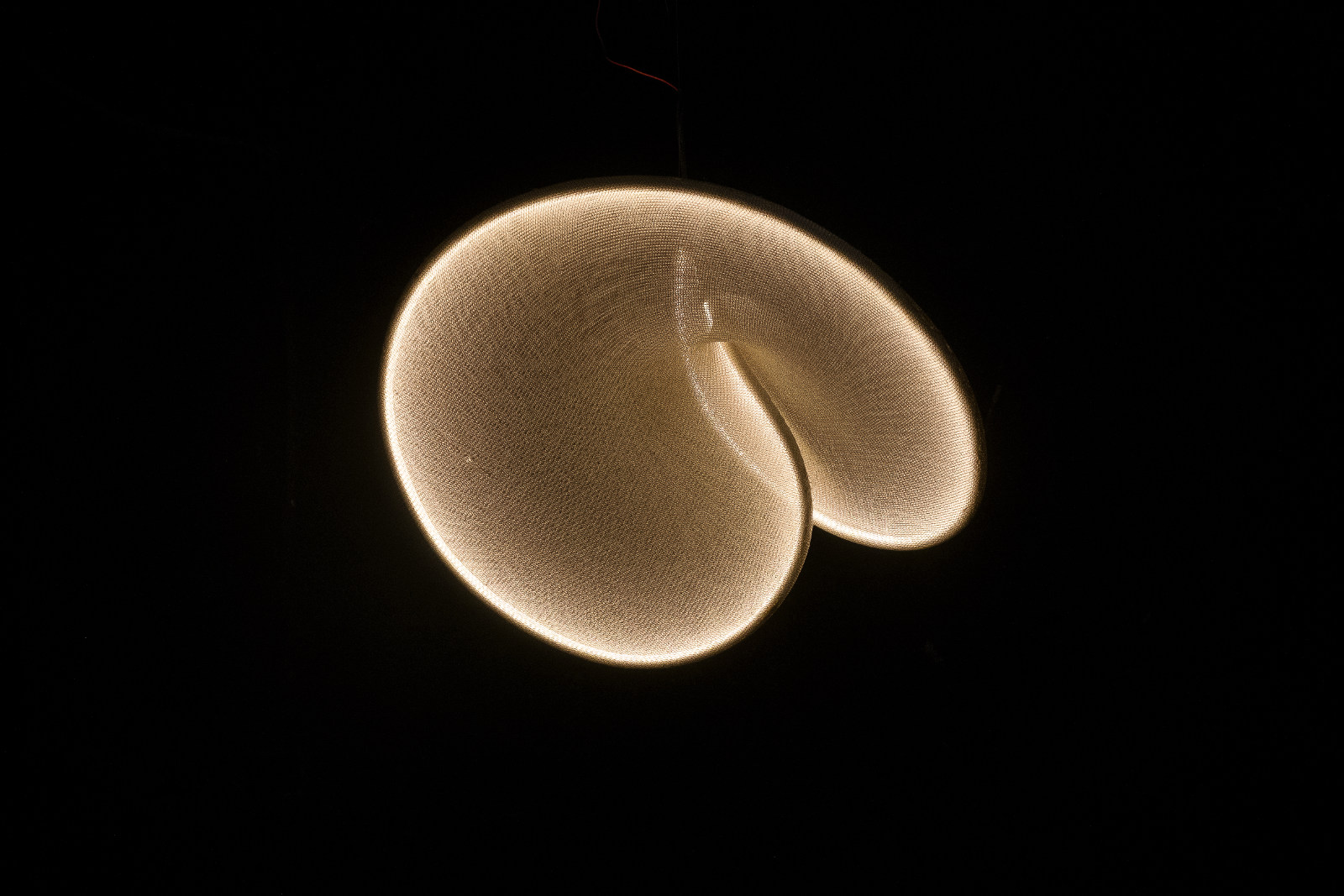
llll.01 a single continuous gesture of hand‑bent metal wrapped in translucent knitted fabric, forming a soft minimal surface that shifts with every angle. Its geometry evokes a chalice‑like volume and reveals a surprising depth as the viewer moves around it — lines overlap, curves open and close, and the moiré pattern shimmers gently in the light.

The lamp is constructed by stretching a custom‑knitted textile (50% polyester, 50% stainless steel) over a precisely shaped frame. This creates a hollow, weightless volume that feels both organic and architectural. The fabric’s semi‑transparency allows the underlying structure to remain visible, giving the piece its characteristic sense of buoyancy.

A warm white LED strip is integrated along the inner edge of the frame, illuminating the lamp from within. This edge‑lighting technique produces a soft, even glow that enhances the layered textile and brings the moiré effect to life.

  • The white/silver fabric is paired with a 2700K LED, offering a warm, neutral radiance.
  • The gold‑toned fabric combines a 2300K LED with the textile’s golden tint, creating a deeper, atmospheric glow.

Because the fabric is knitted, subtle variations in pattern and density naturally occur. These irregularities are part of the material’s character and reflect the artisanal nature of the process. Despite its delicacy, the textile is durable and easy to maintain: dust can be removed with a vacuum cleaner on low suction, and marks can be treated with a mild textile cleaner.

llll.01 works beautifully as a single sculptural pendant or in multiples, where the interplay of curves and shadows becomes even more dynamic. Its quiet presence makes it suitable for both intimate residential spaces and larger architectural environments.

Dimensions
llll.01.3suspendedwhite2700K60/60/60 cm
llll.01.4suspendedgold2300K60/60/60 cm
llll.01.5standingwhite2700K180/60/60 cm
llll.01.6standinggold2300K180/60/60 cm

The LED lightings can have dimmable functions, allowing you to adjust brightness. 

However their internal electrical circuitry doesn’t interpret the wall dimmer signal. Which works for traditional incandescent bulbs only. LED strips don’t connect directly to 120V/220V AC wall sockets. They need a power supply to convert AC into lower 24V DC voltage.

For small projects that consist of just a single power supply, you’ll need the simpler PWM or TRIAC  dimmers

DALI, 0-10v, and DMX LED dimmers can manage multiple zones.

PWM Dimming

or “pulse width modulation”  is a digital signal that “talks” to your strip’s power supply to adjust brightness. You can install a DC PWM dimmer between a standard, non dimmable power supply and the LED strip.

The power supply can be any standard DC power unit and does not need to be dimmable.

Compared to TRIAC dimmable power supplies, these cost cheaper and are readily available. This simple circuit design works well for portable installations where you don’t have to build a dimmer into a wall. DC PWM dimmers are very simple to assemble, easily connecting to the power supply and LED strip.

There are different PWM dimmers available:

RF Dimming provides a remote way to adjust your strip brightness.

Unlike the wired inline LED dimmers, you can dim the led strip by remote control, the distance can get as far as 20 meters in diameter.

WIFI Dimming

A smart dimmer allows you to control your LEDs remotely via a WiFi connection. When setting up a “smart” home or office lighting system, these dimmers are necessary.

You can operate the dimming by using a mobile app. This feature lets you adjust brightness using Alexa or Google Assistant voice controls.

Triac Dimming

Triac dimmer change 120V/220V AC to 12/24V DC signal for led strip lights., and Interpret dimming signals produced by the Triac dimmer and then translate that into the LED strip’s output.

You’ll need to connect the TRIAC dimmer to the dimmable power supply, then link the power supply’s output to the LED strip.

To avoid voltage drops, ensure that your power unit stays close to your strip lights.

1-10V Dimming

0-10V dimming lets you adjust brightness by altering DC voltage powering your strips.

It can vary voltage between zero and ten volts – zero being “off” and ten at 100% brightness output.

This method lets you link as many dimming receivers as your project requires. This means you’ll be able to manipulate many dimmable LED lights simultaneously.

DALI Dimming

DALI dimming is a step further from the 0-10V system. Like the 0-10V, this dimmer allows you to adjust many LED strips over a wide area using a central controller.

This method also allows individual users to adjust brightness for specific zones using smaller LED dimmers.

This setup makes for a convenient way to adjust brightness without going all the way to the main switch. Like its 0-10V predecessor, you’ll have to wire it between the dimmable strips and the transformer.

 DMX Dimming

“DMX 512” also works by regulating voltage in the transformer to reduce brightness.

Despite being an old dimming method, DMX is still used today. Applications include large-scale installations, such as concerts, theatre, and other performance venue lighting. This method allows for independent control of different areas of the lighting project. It can run up to 512 DMX receivers, also called channels.


Surge wattage occurs when you turn on other electrical appliances in your home. The wirings on these appliances create a resistance in the home’s electricity. This sudden change causes a voltage drop in your LED lights.


Surge wattage dimming becomes noticeable when you set your LEDs on low brightness. If your brightness is high, you’ll rarely experience flickering.


 llll.02.3singlewhite2700k60/60/60cm  
 llll.02.4singlegold2300k60/60/60cm  
 llll.02.7doublewhite2700k150/150/60cm  
 llll.02.8doublegold2300k150/150/60cm  
 llll.02.9chandelier 4 elementswhite2700k300/150/150cm  
 llll.02.10chandelier 4 elementsgold2300k300/150/150cm  


The LED lightings can have dimmable functions, allowing you to adjust brightness. 

However their internal electrical circuitry doesn’t interpret the wall dimmer signal. Which works for traditional incandescent bulbs only. LED strips don’t connect directly to 120V/220V AC wall sockets. They need a power supply to convert AC into lower 24V DC voltage.

For small projects that consist of just a single power supply, you’ll need the simpler PWM or TRIAC  dimmers

DALI, 0-10v, and DMX LED dimmers can manage multiple zones.

PWM Dimming

or “pulse width modulation”  is a digital signal that “talks” to your strip’s power supply to adjust brightness. You can install a DC PWM dimmer between a standard, non dimmable power supply and the LED strip.

The power supply can be any standard DC power unit and does not need to be dimmable.

Compared to TRIAC dimmable power supplies, these cost cheaper and are readily available. This simple circuit design works well for portable installations where you don’t have to build a dimmer into a wall. DC PWM dimmers are very simple to assemble, easily connecting to the power supply and LED strip.

There are different PWM dimmers available:

RF Dimming provides a remote way to adjust your strip brightness.

Unlike the wired inline LED dimmers, you can dim the led strip by remote control, the distance can get as far as 20 meters in diameter.

WIFI Dimming

A smart dimmer allows you to control your LEDs remotely via a WiFi connection. When setting up a “smart” home or office lighting system, these dimmers are necessary.

You can operate the dimming by using a mobile app. This feature lets you adjust brightness using Alexa or Google Assistant voice controls.

Triac Dimming

Triac dimmer change 120V/220V AC to 12/24V DC signal for led strip lights., and Interpret dimming signals produced by the Triac dimmer and then translate that into the LED strip’s output.

You’ll need to connect the TRIAC dimmer to the dimmable power supply, then link the power supply’s output to the LED strip.

To avoid voltage drops, ensure that your power unit stays close to your strip lights.

1-10V Dimming

0-10V dimming lets you adjust brightness by altering DC voltage powering your strips.

It can vary voltage between zero and ten volts – zero being “off” and ten at 100% brightness output.

This method lets you link as many dimming receivers as your project requires. This means you’ll be able to manipulate many dimmable LED lights simultaneously.

DALI Dimming

DALI dimming is a step further from the 0-10V system. Like the 0-10V, this dimmer allows you to adjust many LED strips over a wide area using a central controller.

This method also allows individual users to adjust brightness for specific zones using smaller LED dimmers.

This setup makes for a convenient way to adjust brightness without going all the way to the main switch. Like its 0-10V predecessor, you’ll have to wire it between the dimmable strips and the transformer.

 DMX Dimming

“DMX 512” also works by regulating voltage in the transformer to reduce brightness.

Despite being an old dimming method, DMX is still used today. Applications include large-scale installations, such as concerts, theatre, and other performance venue lighting. This method allows for independent control of different areas of the lighting project. It can run up to 512 DMX receivers, also called channels.


Surge wattage occurs when you turn on other electrical appliances in your home. The wirings on these appliances create a resistance in the home’s electricity. This sudden change causes a voltage drop in your LED lights.


Surge wattage dimming becomes noticeable when you set your LEDs on low brightness. If your brightness is high, you’ll rarely experience flickering.


Canopy or rosette?

All lights require a 24V DC constant driver. 

It can be installed either in a canopy on the ceiling or remotely.

The canopy may be white, black, or brass. When the driver is placed remotely, a round ceiling cap will suffice.


The fabric is a knitted blend of half polyester half stainless steel.

The fabric options include a plain white/silver variant (right in the image above) or a with a golden sheen (left).

A warm white LED strip,  embedded within the frame, lights the lamp from the edges, casting an even, soft radiance throughout.

The “white” fabric features a 2700K LED color, whereas the “gold” achieves its golden glow partially from the 2300K LEDs and partially from the fabric color.

The stainless steel ensures the fabric’s durability and ease of maintenance. Minor irregularities in the pattern and colour of the fabric are intrinsic to the knitting process.

The fabric can be cleaned with a vacuum cleaner and a mild textile cleaner.

For any question or price request 

    For any question or price request